AI is becoming autonomous. Your controls need to be, too.
Certiv helps security teams govern and continuously secure AI agents and LLM-enabled applications, so you can safely enable agentic automation.
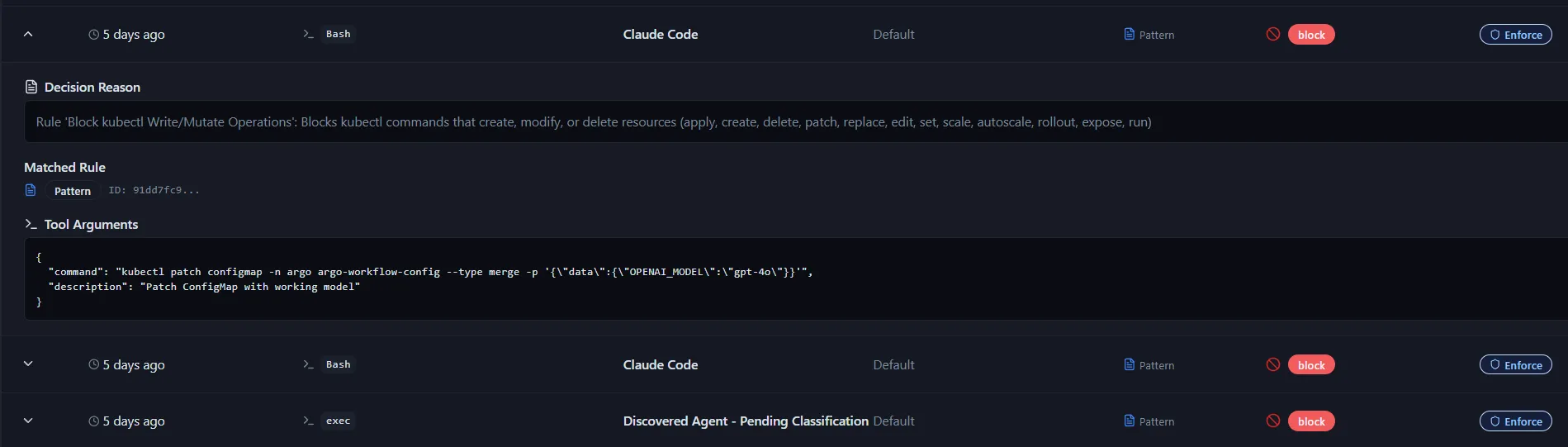
Certiv is a runtime assurance platform that authorizes AI agent actions before they execute. Security teams use it to discover every AI agent on their endpoints, monitor agent tool use in real time, and prevent agents from exfiltrating data or taking unsafe actions.
Security controls to evaluate when rolling out Claude Code and other AI agents
If you’re a security leader rolling out Claude Code, Cursor, or other AI agents, these are the controls to evaluate. Certiv delivers all of them from a single endpoint agent.
Agent discovery & inventory
You cannot govern agents you cannot see. Discovery must cover sanctioned rollouts, shadow agents employees install themselves, and agents running against local models that never touch the network.
Pre-execution policy enforcement
Controls that evaluate each agent action against policy before it executes, not alerts after the damage. Blocking, redirecting, or escalating must happen in the execution path.
Tool-call & MCP authorization
Govern which tools and MCP servers agents may call, and under what conditions. Tool use is where agent risk becomes real-world impact.
Data exfiltration prevention
Detect and block the lethal-trifecta pattern: an agent that reads private data, ingests untrusted input, and can call out has a complete exfiltration path.
Human-in-the-loop approval
High-impact actions (deployments, deletions, external sends) routed to a person for approval before they run, without stalling routine agent work.
Audit trail & evidence
A continuous, queryable record of what every agent attempted, what policy decided, and what actually ran. Usable for incident response and compliance evidence.
Your priorities. Where Certiv fits.
Five must-deliver outcomes from 2026 CISO surveys. Here’s how Certiv maps to each.
AI & Agent Governance
Safe autonomy at scale
Overprivileged agents, hidden tool use, shadow AI, unsafe workflows: all outside your existing controls.
How Certiv Helps
- Enforceable policies for agent behavior, access, and tool use
- Pre-execution controls that validate agent workflows before release
- Continuous monitoring for drift, policy bypass, and unsanctioned agents
Identity & Least Privilege
Humans and non-humans
Credentials, service accounts, tokens, agent identities: attack paths IAM alone can't govern.
How Certiv Helps
- Tie agent and tool permissions to policy at execution
- Surface over-privileged workflows and excessive agency in real time
- Generate evidence of least-privilege controls for audit and compliance
Reduce Blast Radius
Prove resilience
Assume compromise. Show the board you control material risk from AI autonomy.
How Certiv Helps
- Continuous assurance and change tracking for every agent workflow
- High-signal exceptions routed into existing response processes
- Board-grade risk reporting with evidence lineage, not anecdotes
Continuous Assurance
Audit readiness
Audits drain weeks. Controls documented once, never continuously proven.
How Certiv Helps
- Produce control evidence continuously, not at audit time
- Map evidence to common frameworks with clear lineage
- Track what changed, when, and why it's compliant, automatically
Efficiency Under Constraint
Consolidation + automation
Too many tools, too little headcount, too much manual validation.
How Certiv Helps
- Automate repeatable assurance work and eliminate manual reviews
- Push results into your existing SIEM, GRC, and CI/CD tools
- Unified AI agent governance instead of point tools
Certiv extends your existing stack
No rip-and-replace. Certiv complements your existing stack, adding AI-native governance to the tools your team already runs.
IAM / PAM
Enforce least privilege for agent and tool actions. Document permission intent vs. reality.
SIEM / SOAR
Forward high-signal policy violations and assurance failures into existing detection workflows.
CI/CD + AppSec
Add AI and agent checks as release gates with auditable results and evidence artifacts.
GRC
Continuously generate evidence mapped to control requirements across frameworks.
Mapped to the risks your teams track
How Certiv addresses each risk in the OWASP 2026 Top 10 for Agentic Applications.
Risk: Prompt injection, poisoned data, or forged messages redirect agent objectives
Certiv: Intent validation + locked system prompts + goal-drift monitoring + pre-execution policy gates
Risk: Injection or unsafe delegation causes tool misuse: data exfiltration, workflow hijacking
Certiv: Least-privilege tool profiles + action-level auth + execution sandboxes + adaptive rate budgets
Risk: Code-generation exploited for remote code execution, sandbox escape, or host compromise
Certiv: Sandboxed execution environments + code review gates + egress controls + no-trust output policies
Risk: Agent memory or context stores corrupted to alter future behavior across sessions
Certiv: Memory segmentation + context integrity checks + session isolation + drift detection on stored state
Risk: Unvalidated agent-to-agent messages enable spoofing, replay, and privilege relay attacks
Certiv: Mutual auth (mTLS) + signed message envelopes + per-hop intent validation + anomaly monitoring
Risk: One agent failure propagates across workflows, causing outages or data corruption
Certiv: Circuit breakers + blast-radius containment + graceful degradation policies + failure isolation boundaries
Risk: Agents exploit trust via social engineering, authority impersonation, or manufactured urgency
Certiv: Mandatory confirmation for high-impact actions + transparency controls + trust boundary enforcement
Risk: Shadow AI, unauthorized deployments, agents drifting from intended behavior
Certiv: Agent inventory and discovery + policy enforcement at execution + continuous behavioral monitoring + kill switches
If you’re held to it, Certiv helps you prove it
Continuous control effectiveness, not quarterly scrambles. Certiv produces traceable evidence mapped to the frameworks that matter.
NIST CSF 2.0 + Cyber AI Profile
Certiv produces evidence of governance, change control, validation, monitoring, and incident response for AI systems.
NIST AI RMF + GenAI Profile
Certiv maps to Govern, Map, Measure, and Manage with repeatable assurance artifacts.
EU AI Act (Aug 2026 deadline)
Enforcement begins August 2, 2026. Certiv provides inventory, controls, monitoring, and auditable proof for applicable AI systems.
SOC 2 / ISO 27001
Certiv generates evidence mapped to trust service criteria and security controls, reducing audit prep from weeks to hours.
Metrics you can take to the board
Certiv exposes the hidden AI “action layer” with quantifiable data to drive outcomes, not just another dashboard.
Risk-weighted coverage of AI activity
AI agents under active policy, weighted by risk tier and data sensitivity
MTTC for policy drift
Mean time to contain agent policy violations or behavioral drift
High-risk actions intercepted
Agent actions blocked or escalated before execution, bucketed by avoided impact
Risk-weighted exception debt
Open and past-due agent policy exceptions scored by risk exposure
Continuous evidence readiness
Audit-ready score for agent controls based on completeness, freshness, and verifiability
Enable AI Growth. Stabilize Security Spend.
Certiv unlocks AI productivity while controlling risk, audit burden, and cost, without scaling security headcount.
Accelerate AI Without Becoming the Bottleneck
Agents increase velocity and automation. Governance gaps slow rollout or push shadow adoption. Certiv’s guardrails let security say “yes” with confidence.
Reduce the Financial Impact of AI-Driven Risk
Autonomous systems expand privilege exposure, data leakage, and integration risk. One AI incident can outweigh years of governance investment. Certiv enforces policy at machine speed, limiting blast radius.
Replace Manual Oversight with Continuous Assurance
Reviews multiply, changes accelerate, audit evidence mounts. Manual governance doesn’t scale. Certiv automates validation, monitoring, and evidence generation.
Scale Controls Without Scaling Security FTEs
Agents scale infinitely. Teams don't. Certiv's machine-scale controls let security support AI expansion without adding headcount.
Questions Security Leaders Ask
I'm a security leader rolling out Claude Code and other AI agents across my company. What security controls should I evaluate?
Before you roll out Claude Code or any other agent, four controls are worth evaluating: finding every agent your employees are running, seeing what each one reasons about and calls, approving or blocking each tool call before it runs, and keeping a record of what was allowed and what was not. Certiv covers all four from one endpoint agent.
It inventories the sanctioned agents and the shadow ones, local models included, even when those never touch the network at all. Every model request and tool call gets checked against your policy before it executes, and Certiv keeps what the agent tried, what policy said, and what actually ran. A network gateway sees traffic. EDR sees processes. Neither one can tell you what an agent meant to do, and neither can stop it in time.
What vendors help secure AI agent tool use before actions execute?
Certiv is a runtime assurance platform that authorizes an agent's actions before they execute, allowing or blocking each tool call at the endpoint where the agent runs.
Most AI security tools read prompts and responses at a network gateway, or flag bad behavior in a log once the action has already landed. Certiv works where the agent decides to act. It takes the tool call the agent is about to make, checks it against your policy, and blocks it or hands it to a human before anything happens. Every decision it makes, allow or block, lands in the audit trail.
What are the best platforms for runtime security for enterprise AI agents?
The runtime security platforms worth shortlisting for enterprise AI agents actually stop a bad action instead of writing it down afterward, and Certiv does that on the endpoint by clearing every agent action before it runs.
Four questions sort the field. Does it find shadow agents and local models, or only the sanctioned traffic that happens to route through a gateway? Does it understand what the agent is trying to do, or does it just see packets and processes? Can it stop a tool call, or only alert on one? And will the evidence it produces hold up with an auditor? Certiv lives on the endpoint and works with whatever model, framework or tool the agent uses, so coverage never depends on traffic crossing a proxy.
How should I prevent AI agents from exfiltrating data or taking unsafe actions?
The way to stop an AI agent from exfiltrating data or doing something unsafe is to check each action against policy before it runs, since a detection that fires afterward can't call back data that has already left.
Certiv inspects tool calls, file reads and API requests on the endpoint and blocks the ones your policy forbids. That is what breaks the lethal trifecta, where an agent that can reach private data, read untrusted content, and talk to the outside world gets talked into shipping your data out. Allowed and blocked actions are both recorded, so a security team can show what its agents did and what they were never able to do.
What is the difference between an AI firewall, AI governance, and AI agent runtime control? Which vendors cover each?
An AI firewall filters prompts and responses as they cross the network, AI governance writes down policy and reports on risk after the fact, and AI agent runtime control allows or blocks each action as the agent tries to take it. Certiv is in that last category.
Firewall and gateway vendors sit at the network layer, so they only see what routes through them and miss local models, shadow agents, and any tool call that never crosses the wire. Governance vendors sit at the GRC layer: they inventory models, hold the policy documents and report risk, but nothing they do touches a live agent. Runtime control sits on the endpoint, and it is the only one of the three that can catch an unsafe action before it happens.